Product highlights
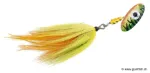
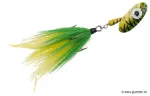
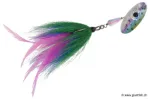
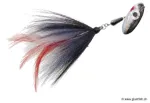
Designed by Panther Martin, the Big Eyes Muskie spoon is an oversized metal lure specially developed to target very large predators. Its holographic blade produces intense flashes and strong vibrations that travel deep into the water column. The oversized eye visual acts as a true strike trigger, targeting wary or inactive fish.
This pike and catfish spoon stands out with a dense bucktail-style fiber dressing. The voluminous skirt enhances the lure's silhouette, increases lift and creates significant water displacement, making it irresistible to predators focused on large prey. The combination of the spinning blade, holographic finish and bucktail provides a highly distinctive visual and vibratory cue, even in stained water.
The Big Eyes Muskie Panther Martin is designed for intensive prospecting of deep zones, holes, drop-offs, inflows and cluttered edges where large specimens hold. Its robust construction, heavy-duty rigging for powerful jaws and excellent stability at various retrieval speeds make it a reliable ally for targeting record pike and massive catfish.
Technical specifications
- Oversized metal spoon for targeting large freshwater predators.
- Holographic blade delivering strong flashes and steady vibration.
- Oversized eye visual to focus strikes toward the rear of the lure.
- Dense bucktail-style dressing to increase volume and water displacement.
- Equipped with strong treble hook(s) suitable for large jaws.
- Body engineered for stable rotation, even at low retrieve speeds.
- Available in several sizes to adjust running depth and casting distance.
- Intended for cast-and-retrieve, steady retrieves or jerk-and-pause presentations near the bottom.
- Suitable for rivers, large streams, canals, lakes and major dams in freshwater.
- Designed for pike, catfish and opportunistic large predators.
Advantages and strengths
The primary strength of the Big Eyes Muskie spoon lies in its ability to be noticed from a long distance. The holographic blade combined with the oversized eye mimics both the flash of a wounded baitfish and the head of an easy meal, triggering reflex strikes from dominant predators. The voluminous bucktail creates a pulsating, lively trail with each blade rotation.
This large pike and catfish spoon is particularly effective in murky or low-light waters where contrast and vibration are key. Its generous profile helps select larger fish and attracts predators that may ignore subtler lures. Its weight and shape ensure excellent casting performance, even into the wind, to reach distant holding spots.
Another major advantage is its overall durability. The wire, split rings and hooks are designed to withstand heavy fights and the abrasive teeth of large predators. The blade rotation remains smooth, ensuring steady action, reducing drop-offs and maintaining maximum attractiveness throughout the retrieve.
Usage tips
The Big Eyes Muskie performs best on a controlled cast-and-retrieve. After the cast, let it sink to the desired depth, then start a steady retrieve, occasionally varying the speed to change vibration frequency. Short pauses followed by several quick turns of the reel often provoke strikes from following fish.
For pike, target weed edges, hole heads, marked drop-offs and wooded or structure-rich shorelines. For catfish, focus on deep holes, strong current seams, confluences and submerged obstacles. A powerful rod, strong braided line and a leader suitable for predator teeth are recommended to fully exploit this pike and catfish spoon.
Don’t hesitate to vary retrieve speeds during a single cast to find the cadence that triggers the most strikes. In very cold water, slow, near-bottom presentations are often more productive, while in peak season a faster retrieve can provoke violent attacks from active fish.
FAQ
Question 1: For which species is the Big Eyes Muskie recommended?
Answer: It is primarily designed for pike, catfish and other large freshwater predators.
Question 2: In which environments should I use this spoon?
Answer: The Big Eyes Muskie is used in rivers, large streams, canals, lakes and dams—especially over deep holes, drop-offs, holes and cluttered edges.
Question 3: What type of presentation is most effective with this lure?
Answer: A cast-and-retrieve with occasional speed variations, punctuated by pauses and restarts, best exploits the blade vibration and bucktail volume to trigger strikes.