Product highlights
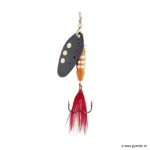
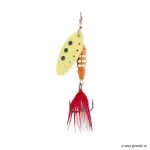
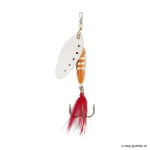
The Toni spinning spoon is a classic lure to keep in any tackle box, designed to trigger bites when fish become cautious. Its principle is simple and highly effective: a blade that spins on the retrieve combines vibration and flash, awakening the strike instinct of predatory and opportunistic fish.
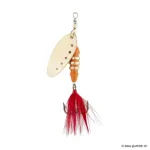
This model stands out with a blade drilled with 5 holes of different diameters. This design changes the water resistance and the beating frequency, creating an irregular signal that is especially attractive. The result is a livelier swim, with pulsations that can be felt through the rod and remain easy to read even in low light or slightly stained water.
The orange body combined with a brass finish delivers a strong visual contrast. Together, they produce natural, warm reflections that help attract attention without overdoing it. Finally, the hook is concealed by a fly: this detail adds volume and a touch of texture that can help finish the strike while masking part of the metal.
Technical specifications
- Type: spinning spoon
- Weight: 7 g
- Blade: perforated with 5 holes of different sizes
- Body: orange color, brass finish (natural look)
- Hook: fitted with a concealing fly
Benefits and key product features
The Toni 7 g is designed to fish effectively without unnecessary gimmicks. The perforated blade creates a distinctive effect: in rotation, it generates a vibration signature that subtly changes with retrieve speed and line tension. This variability is a real advantage when fish follow without striking or when you need to stand out from lures that are too regular.
Its profile remains versatile: compact enough to cover water, visible enough to be noticed. The combination of the orange body and brass reflections gives quick visibility in the water and maintains strong attraction in many situations. As for the fly on the hook, it adds a bite target and can help turn tentative strikes into more solid hookups.
In use, this is a practical lure for covering water: streams, rivers, canals, and stillwaters. It works equally well for fast searching approaches or slower presentations, using retrieve speed to adjust blade rotation and vibration intensity.
How to use
To get the best from this spinning spoon, start with a fan cast to sweep across different lanes of water. Let it sink for a few seconds if needed, then begin a steady retrieve, just fast enough to keep the blade spinning continuously. After that, vary the pace: short accelerations, micro-pauses, or a slower retrieve. These rhythm changes especially highlight the perforated blade and can trigger strikes from following fish.
In rivers, cast across or slightly upstream and let the current help you maintain control. In stillwaters, focus on banks, drop-offs, and areas with visible activity. Use a leader suited to the target species and check the hook point regularly, especially after contact with obstacles.
Testimonials
"A simple but terribly effective spoon. The perforated blade really makes a difference when bites are scarce."FAQ
Question 1: What does the perforated blade offer compared with a classic blade?
Answer: The holes change the resistance in the water and create a less monotonous vibration, which can trigger wary fish while keeping a stable rotation.
Question 2: When should it be used first?
Answer: It is ideal for prospecting when you need to cover an area quickly, and it remains very relevant when you want to stimulate aggression through strong vibrations and visible flashes.
Question 3: Is the fly on the hook only for decoration?
Answer: No, it adds volume and masks part of the hook, which can help finish the strike and improve how well the lure stays in the fish's mouth during the bite.