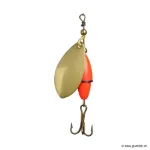
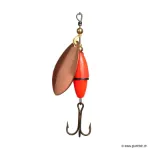
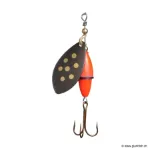
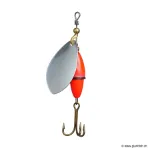
Product Highlights
The spinning spoon Myran Akka is designed for anglers who want a simple, effective, and enjoyable lure to use. Recognized as a classic in the Myran range, it stands out for its instant handling: it rigs easily, casts well, and swims without any complications. Its concept focuses on the essentials, with a rotating action that triggers strikes through both visual and vibration signals. If you are looking for a versatile fishing lure capable of covering many situations without needing a long list of references, the Akka delivers.
Its main strength is its ability to stay productive in a wide range of conditions. During prospecting, a spinning spoon has the advantage of working from the very start of the retrieve, making it effective for short spots, bank edges, current seams, or open water. The Akka fits this approach perfectly: it allows active, steady fishing and proves deadly on many species, whether they are feeding aggressively or simply following before committing.
Technical Features
- Category: spinning spoon (spinner)
- Fishing style: casting and retrieving, prospecting
- Waters: rivers, lakes, canals, ponds
- Retrieve: linear retrieve with blade rotation
- Key advantage: easy to cast and easy to use
- Positioning: classic Myran lure, all-round bait
Product Benefits and Key Advantages
What makes a good spinning spoon so effective is its ability to trigger bites when fish are active, but also to provoke a reaction on a precise pass. The Myran Akka is an excellent balance of simplicity and efficiency: it lets you fish fast, cover water, and quickly find the right retrieve speed. Its behavior gives confidence to the angler: it is easy to tell when the lure is working, which helps maintain a steady animation and stay focused on the key areas.
Another major advantage is versatility. A spinning spoon is often the ideal tool for varying your prospecting angles. In rivers, it cuts through current, follows bank edges, and explores back eddies. In still waters, it helps you work drop-offs and sparse weedbeds by adapting the retrieve speed. With the Akka, you get a fishing spinner that works just as well for discovering a new spot as it does for repeatedly working a promising one.
Finally, its status as a classic is no accident: this is the kind of lure you keep in your tackle box because it is useful all year round. When you want a reliable solution without gimmicks or fine-tuning, you naturally turn to a spinning spoon that can tempt a wide range of fish.
How to Use
To get the best from the Myran Akka, use a simple and methodical approach. After the cast, begin the retrieve gradually so the blade starts rotating, then settle into a steady speed. Next, vary your casting angles: fan casts, retrieves parallel to the bank, or controlled drifts in rivers while letting the current assist the lure’s action. A spinning spoon also excels when you subtly change pace: a short burst of speed followed by a return to a constant retrieve can trigger a strike.
Adapt your tackle to casting and retrieving. A responsive rod and a line suited to your fishing style make casting and accuracy easier. In snaggy areas, keep your trajectories clean and your retrieves controlled so the lure does not drift into obstacles. In clear water, stay discreet and cast farther: one of the benefits of a model that is easy to cast is that you can fish at distance without forcing the cast.
Testimonials
""A true all-purpose lure: I use it whenever I want to prospect quickly and stay effective without overthinking it. It is the kind of spinner that inspires confidence from the very first casts.""FAQ
Question 1: Is the Myran Akka suitable for beginners?
Answer: Yes, it is a spinning spoon that is easy to get used to: it casts well and works on a steady retrieve, making it ideal for learning the basics of casting and retrieving.
Question 2: Which waters is it best used in?
Answer: It is versatile and can be used in rivers, lakes, or ponds. The key is to cover active areas: banks, current seams, drop-offs, and marked spots.
Question 3: Which animation is the most effective?
Answer: A steady retrieve that keeps the blade rotating, punctuated by small speed changes. These rhythm variations are often enough to trigger following fish.