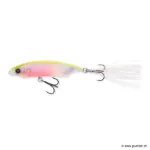
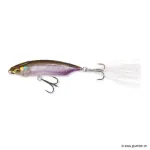
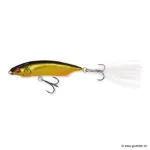
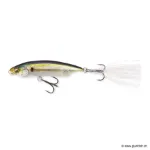
Product Highlights
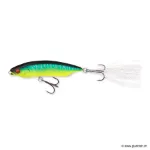
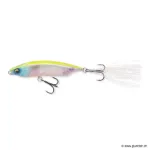
The MEGABASS Karashi 80 is a sinking lure in stickbait form, designed to work in the thin layer of water just beneath the surface film. This position is highly effective when fish follow without striking on top, or when fishing pressure calls for a more subtle approach. Thanks to its hydrodynamic design and precise internal balance, it maintains a clean track even at slow speeds while remaining highly responsive to rod inputs.
Its swimming action combines several styles: a tight, sharp walking the dog presentation, wider lateral sweeps on firm pulls, and controlled glides that naturally imitate a small baitfish in distress. Vibrations remain subtle, helping fool wary predators in difficult conditions such as clear water, educated fish, and heavily pressured spots.
Technical Features
- Type: sinking stickbait for sub-surface searching
- Action: tight walking the dog, twitching, lateral glides, and straight retrieve
- Behavior: excellent stability on slow retrieves, immediate response to rod twitches
- Design: streamlined body for fine vibrations and natural presentation
- Casting: internal system designed to deliver strong casting performance for a compact profile
Product Benefits and Key Advantages
The main advantage of the Karashi 80 is its tactical versatility: it can be fished as a reaction lure or as a lure of persistence. On a steady retrieve, it keeps a clean and consistent swimming action, ideal for covering banks, shallow drop-offs, surface weed edges, or zones holding small baitfish. With a jerky retrieve, it turns into a panicked prey item, alternating micro side-to-side movements and rhythm changes that trigger reflex strikes.
Its sub-surface approach is especially useful when surface lures are too visible or too noisy. By staying just under the water, the lure remains constantly in the fish's field of view while reducing the alert effect sometimes caused by splashes. This makes it an excellent choice for black bass fishing and perch fishing, especially on followers, in high-sun conditions, or when the forage consists of small moving prey.
The finesse of its signals, both in vibration and movement, also helps mimic a wounded baitfish: short pauses, renewed pulls, then a lateral glide. This ability to chain together realistic sequences gives anglers precise control over running distance, speed, and escape angle, so the presentation can be adapted to the fish's reaction.
How to Use
To get the most out of this sinking stickbait, cast beyond the target area, then begin with a slow retrieve to place the lure just under the surface. Vary the cadence: two or three short rod twitches for a tight walking the dog action, a brief pause, then a stronger twitch to create a pronounced sideways dart. Strikes often come on changes of pace such as pauses, restarts, and short bursts of speed.
When fish are wary, use short, clean animations with frequent pauses to let the lure “live” and drift sideways. When fish are actively feeding, increase the speed and chain together twitch sequences to imitate a panicked escape. For searching water, alternate straight retrieve and jerky action in the same cast: this switch is often enough to trigger a fish that was following without striking.
FAQ
Question 1: What is a sinking stickbait like the Karashi 80 used for?
Answer: It allows you to fish the sub-surface layer with a more subtle presentation than a surface lure, while still offering walking the dog, twitching, and lateral glide actions.
Question 2: Should it be worked with a steady retrieve or a jerkbait style retrieve?
Answer: Both work. A steady retrieve is effective for searching and covering water, while jerkier presentations (twitches, pauses, restarts) are excellent for triggering reflex strikes from following fish.
Question 3: In what conditions is this lure most useful?
Answer: It performs especially well when fish are wary, in clear water, under heavy fishing pressure, or when surface strikes are scarce and you need to stay just beneath the surface film.