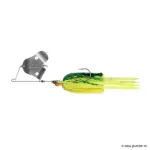
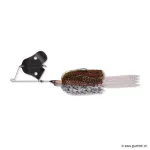
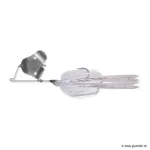
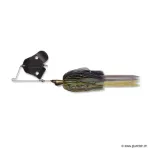
Product advantages
The MEGABASS Jamaica Boa JR Super Metal is a surface buzzbait for predators specially developed to provoke reactions from fish holding in shallow water. Designed to quickly cover large areas, it combines strong prospecting capability with exceptional sound attraction, making it an excellent choice for pike fishing, largemouth bass and other freshwater predators that hunt near the surface.
Its design emphasizes metallic noise and strong vibrations. The asymmetrical blade mounted on an offset shaft produces an irregular splash, chattering and a pronounced wake, imitating the panicked escape of prey. When the blade strikes the rattle integrated into the body, the sound signal is further amplified to trigger reflex strikes, even from wary or inactive fish.
With its rear-positioned weight, this buzzbait delivers very accurate long-distance casts. Its refined shape allows it to slip efficiently through heavy cover, clearing sparse weedbeds, submerged branches and other obstacles commonly found in predator zones. The robustness of its metal frame makes it a reliable lure, capable of withstanding repeated fights with large fish without deforming.
Technical specifications
- Surface buzzbait designed for fast prospecting in shallow water.
- Weight around 10 g (3/8 oz) to strike a balance between casting distance and ease of retrieval.
- Reinforced metal frame to resist powerful runs and repeated fights.
- Asymmetrical blade on an offset axis generating a mix of high-pitched noise, bubbles and marked vibrations.
- Built-in rattle in the structure to increase the acoustic signal when the blade rotates.
- Profiled head optimized to stay on the surface and pass over light to moderate obstacles.
- Design suitable for spinning or casting rods dedicated to surface predator fishing.
- Available in various finishes to match water clarity and fish mood.
Advantages and strengths
The Jamaica Boa JR Super Metal stands out primarily for its ability to “wake up” fish holding along edges or on shallow flats. In a minimum number of passes, it reveals whether predators are present in a given area, making it an excellent prospecting lure for both mobile fishing and more methodical approaches. Its noisy character and large wake make it particularly effective in overcast conditions, windy weather, or when the water surface is slightly disturbed.
Another major asset is its high stability and its ability to remain effective even at low speed. It can be retrieved slowly to give big fish time to adjust their strikes, or animated quickly to create an irresistible panicked run. Its sturdy construction reassures the angler when fighting a big fish near cover, while the blade + rattle combination offers a unique signal that predators encounter less often than with other lure types.
Usage tips
This buzzbait performs best in shallow heavy-cover areas: weed edges, gentle breaks, shallow bays, flats with timber, sparse reedbeds or areas with scattered lily pads. Cast beyond the target structure, start reeling as soon as the lure touches the water, and maintain a steady retrieve to keep the blade continuously turning on the surface.
Adjust retrieval speed to fish activity: fast to trigger violent strikes from aggressive fish, slower and smoother when predators are wary. Slightly vary cadence, add very short pauses or change the attack angle from pass to pass to provoke bites. Used with low-stretch braid or monofilament, this lure maintains good control of the line and ensures effective hooksets, even at long distance.
FAQ
Question 1 : Which species is this buzzbait best suited for?
Answer: It is ideal for freshwater predators such as pike, largemouth bass and other opportunistic species that frequently hunt near the surface in shallow water.
Question 2 : In which conditions does this lure perform best?
Answer: It excels when the water is warm and fish are willing to rise to the surface, notably in late spring, summer and early autumn, over shallow areas rich in structure and obstacles.
Question 3 : What type of retrieve is recommended with this buzzbait?
Answer: A steady, linear retrieve usually suffices. You can, however, slightly vary speed, add bursts of acceleration or change trajectory to trigger reaction strikes and refine your presentation according to predator behavior.